Reclaiming a Good Name: From Baal Shem Tov to Hamilton to Reentry
A few hundred years ago, the founder of the Chabad movement, the Baal Shem Tov, was known not for wealth or power, but for being “the master of a good name.” Centuries later, Lin-Manuel Miranda echoed that sentiment in Hamilton, writing of his title character:
“He may have committed adultery, but he did not commit treason. He did not sully his good name.”
There’s something universal—and urgent—in that phrase: the desire to protect, or reclaim, a good name.
In the reentry world, we don’t talk enough about this. We talk about jobs. We talk about housing. But what about the deeper, quieter need to clear your name?
This doesn’t mean pretending your past never happened. It means recognizing that you are not the same person who once stood before a judge. You’ve changed. You’ve grown. And where the law allows, you can—and should—take steps to seal, expunge, or reframe your past. Not to erase the truth, but to reflect the reality that you’ve moved forward.
Think of it like this: in a relationship, if something goes sideways, you have to choose. You either accept what happened and commit to rebuilding—or you end the relationship. But you can’t hold onto a grudge and expect the relationship to heal. If your spouse was unfaithful 11 years ago and you’ve both chosen to stay, you can’t relive that betrayal every day. You either forgive, or you walk away. There’s no middle ground that sustains growth.
Now, pivot that same energy to reentry. How long does society get to hold a conviction over someone’s head? If the law says you’re eligible for expungement, then society no longer gets to point to that conviction as a reason not to trust you.
In some states, you can terminate probation early. In others, you can seal or expunge your record. A few even offer pardons. These aren’t just legal steps. They’re strong statements. They say: I’ve paid my debt to society. I’m moving forward—and I expect the world to move forward with me. As an aside, both statements are equally powerful – I’m moving forward as an affirmation to my own intention that I have forgiven myself and I choose to embrace my bright future. And expecting the world to move forward with me is an equally powerful sentiment that strongly says, we are done. If you are more interested about what happened five or ten years ago, out of context, than the person I am today, that says a whole lot more about you then it does about me.
And for those of us whose worst mistakes were blasted across media headlines? We don’t get the luxury of forgetting. But we do have the power to overlay the old story with a new one.
If you’re holding a steady job, raising your kids, volunteering, starting a business—that’s not just “moving on.” That’s reputation management in its purest form.
And here’s the thing: you don’t have to wait for a court order to begin. Rather than filing paperwork, your responsibility is to tell your story. There’s no shortage of podcasters who want to help you share your journey. Find them. Speak your truth. Let Google index that new narrative, and slowly push the old one to page two.
We live in a world obsessed with clean categories: good guy, bad guy. Criminal, saint. But life doesn’t work that way. I’ve never met a “good” person who doesn’t have a secret. And I’ve never met someone who’s been incarcerated for something terrible who doesn’t also do good.
But society doesn’t like complexity. We cling to the idea of “once a criminal, always a criminal.” Meanwhile, for those society views as virtuous, we twist ourselves in knots to excuse the missteps—“he was framed,” “it was fake news,” “that never happened.”
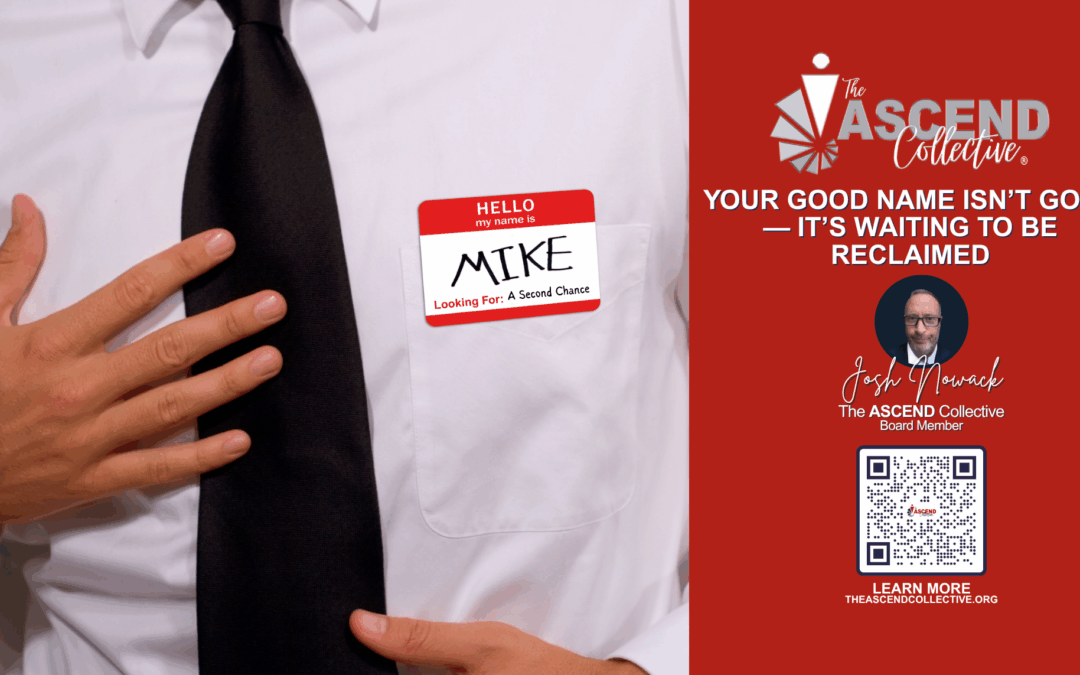
Ultimately, the pathway to reentry includes reclaiming your good name.
And that’s where responsibility comes in—not as blame, but as the ability to respond. You can’t change the past. But you can respond to it—with integrity, with effort, and with grace. You can file the paperwork. You can show up in your community. You can challenge the story others try to write about you. That’s responsibility—not just for you, but for your family, your children, your future.
Because when you reclaim your name, you do more than just “fix” your reputation. You model what’s possible. You show others that failure isn’t final. You remind them that a good name isn’t about being perfect—it’s about consistency, courage, and growth.
As Hamilton later says of George Washington: “He’s a model of integrity. A paragon of virtue.” That kind of honor doesn’t come from never falling. It comes from how you rise. So rise. File the petition. Terminate probation. Expunge the record. Share your story. Reclaim your name.
Not to prove society wrong—but to prove you are absolutely worthy of life’s blessings.
Josh Nowack is a dad, a fair chance employer, and someone who believes deeply in second chances—because he’s lived one. He’s the co-founder of Breaking Free Industries, a custom apparel company in Orange County, California that hires those who’ve been told “no” too many times. Josh also serves as Chief Development Officer and lead instructor at Inmates to Entrepreneurs, where he’s proud to help others build the businesses that can change their lives. He sits on the boards of both Inmates to Entrepreneurs and The ASCEND Collective, and hosts the podcast From Cell to CEO, where he shares real stories of resilience, grit, and growth.
He’s just trying to pay it forward—with purpose, not perfection.
Learn more about the ways you can give back.